

Stages In The Enactment Of The Budget
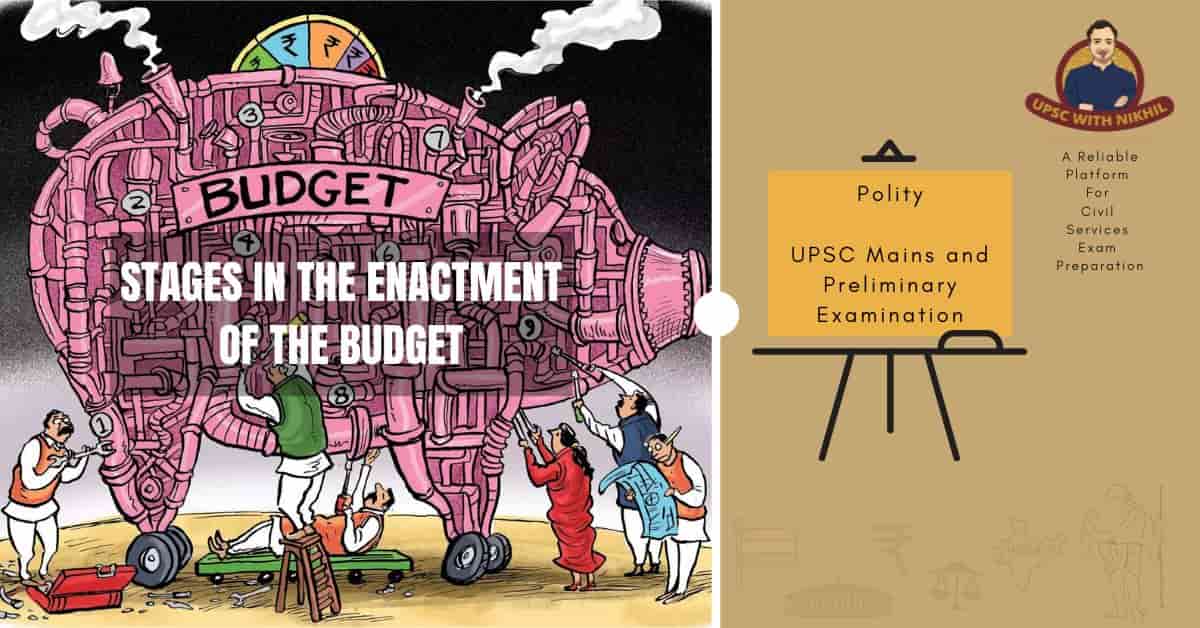
How The Budget is Presented?
The budget is divided into two sections: the Railway Budget and the General Budget. The procedure is the same for both. The Railway Budget is presented first, followed by the General Budget. The former is presented to the Lok Sabha in the third week of February by the railway minister, while the latter is presented to the Lok Sabha on the last working day of February by the finance minister.
1. The Finance Minister delivers a speech known as the "budget speech" when presenting the General Budget. The budget is presented to the Rajya Sabha at the conclusion of the Lok Sabha speech; the Rajya Sabha can only discuss it and cannot vote on grant requests.
2. Discussion in General: A few days after the budget is presented, the general discussion begins. It usually lasts three to four days and takes place in both Houses of Parliament. During this stage, the LokSabha can debate the budget as a whole or on any principle issues raised in it, but no cut motions can be proposed, and the budget cannot be put to a vote in the House. At the conclusion of the debate, the finance minister has a general right of reply.

3. Departmental Committees: Examining The Houses are adjourned for three to four weeks after the general budget discussion is completed. During this time of transition, the 24 departmental standing committees of Parliament examine and discuss in detail the ministers' requests for grants, and prepare reports on them. These reports are presented for consideration to both Houses of Parliament. The parliamentary financial control over ministries is much more detailed, close, in-depth, and comprehensive thanks to the standing committee system, which was established in 1993 (and expanded in 2004).
4. Voting on Grant Requests: The Lok Sabha votes on grant requests after considering the reports of the departmental standing committees. The demands are organised by ministry. After it has been duly voted on, a demand becomes a grant.
In this context, two points should be made. One, the Lok Sabha has exclusive authority over the voting of grant demands; the Rajya Sabha does not have such authority. Second, voting is limited to the parts of the budget that can be voted on; expenditures charged to the Consolidated Fund of India are not up for a vote (it can only be discussed). The Railway Budget has 32 demands, compared to 109 for the General Budget (103 for civil expenditures and 6 for defence expenditures). The Lok Sabha votes on each demand separately. Members of Parliament can discuss the budget's specifics at this stage. They can also make motions to reduce grant requests. These motions are known as 'cut motions.’
What are the Three Types of Cut Motions?
(a) Policy Cut Motion: This motion expresses disapproval of the demand's underlying policy. It specifies that the demand amount be reduced to Re 1. Members can also advocate for a different policy.
(b) Economy Cut Motion: This motion represents the economy that the proposed expenditure may have an impact on. It specifies that the demand amount be reduced by a certain amount (which may be either a lumpsumreduction in the demand or omission or reduction of an item in the demand).
(c) Token Cut Motion: It expresses a specific grievance that falls within the purview of the Indian government. It specifies that the demand amount be reduced by Rs 100.
To be admissible, a cut motion must meet the following requirements:
• It should only be about one demand.
• It should be succinctly stated and free of arguments or defamatory statements.
• It should be limited to a single topic.
• It should not propose changes to or repeals of existing legislation.

• It should not be used to refer to a topic that is not primarily the responsibility of the Union government.
• It should not have anything to do with the Consolidated Fund of India's expenditure.
• It should not be about a case that is currently being decided by a court.
• It should not raise a privilege issue.
• It should not bring up a topic about which a decision has already been made in the same session.
• It should not be about something insignificant.
The importance of a cut motion is two fold: (a) it facilitates the start of focused discussion on a specific grant request; and (b) it upholds the principle of responsible government by probing the government's activities. The cut motion, on the other hand, isn't very useful in practise. They are only moved and discussed in the House, but they are not passed because the government has a majority. Their passage by the Lok Sabha amounts to a vote of no confidence in the government, which could lead to its resignation. The voting of demands will take place over the course of 26 days. On the last day, the Speaker calls a vote on all remaining demands, regardless of whether they have been discussed by the members. The term for this is 'guillotine.'
Passing Of Appropriation Bill
"No money shall be withdrawn from the Consolidated Fund of India except under appropriation made by law," the Constitution states. As a result, an appropriation bill is introduced to provide for the appropriation of all funds required to meet the following needs from the Consolidated Fund of India:
• The Lok Sabha's appropriations.
• The expenditure charged against India's Consolidated Fund.
In either house of Parliament, no amendment to the appropriation bill can be proposed that will have the effect of changing the amount or destination of any grant voted, or changing the amount of any expenditure charged on the Consolidated Fund of India.
After the President signs the Appropriation Bill, it becomes the Appropriation Act. The payments from the Consolidated Fund of India are authorised (or legalised) by this act. This means the government won't be able to withdraw funds from the Consolidated Fund of India until the appropriation bill is passed.
This is a lengthy process that usually lasts until the end of April. However, the government will require funds to continue its normal operations after March 31. (the end of the financial year). To address this practical issue, the Constitution has given the Lok Sabha the authority to make any grant in advance in respect of estimated expenditure for a portion of the fiscal year, pending the completion of the voting on grant demands and the enactment of the appropriation bill. This is known as the 'vote on account' provision. After the general budget discussion is completed, it is passed (or granted). It is usually granted for a period of two months for a sum equal to one-sixth of the total estimate.
Passing Of Finance Bill
The Finance Bill is introduced to give effect to the Government of India's financial proposals for the coming year. It is subject to all of the terms and conditions that apply to a Money Bill. In contrast to the Appropriation Bill, amendments to the Finance Bill (seeking to reject or reduce a tax) can be moved.
The Finance Bill must be enacted (that is, passed by Parliament and signed by the president) within 75 days, according to the Provisional Collection of Taxes Act of 1931. The Finance Act legalises the budget's revenue side and completes the budget's enactment process.
What are the Types of Grants From Other Sources?
Various other grants are made by the Parliament under extraordinary or special circumstances, in addition to the budget, which contains the ordinary estimates of income and expenditure for one financial year:
Supplementary Grant:
When the amount authorised by Parliament through the appropriation act for a specific service for the current fiscal year is found to be insufficient for that year, it is granted. Additional Funding It is granted when a need for additional expenditure on a new service not contemplated in the current financial year's budget arises during that year's fiscal year.

Excess Grant:
When money is spent on a service during a financial year in excess of the amount allocated for that service in the budget for that year, an excess grant is awarded. The Lok Sabha votes on it at the end of the fiscal year. The Public Accounts Committee of Parliament must approve the requests for excess grants before they are submitted to the Lok Sabha for voting.
Vote of Credit:
It is granted to meet an unexpected demand on India's resources when the magnitude or indefinite nature of the service prevents the demand from being stated with the details normally provided in a budget. As a result, it's as if the Lok Sabha has written the Executive a blank check.
Exceptional Grant:
It is given for a specific purpose and is not included in the current financial year's service.
When funds to meet the proposed expenditure on a new service can be made available through re-appropriation, a token grant is given. A request for a token sum (of Re 1) is put to the Lok Sabha for approval, and if approved, funds are made available. Transferring funds from one head to another is referred to as re-appropriation. It does not entail any additional costs.
Supplementary, additional, excess, and exceptional grants, as well as votes of credit, are governed by the same procedure as a regular budget.