

Jawaharlal Nehru And His Ethics
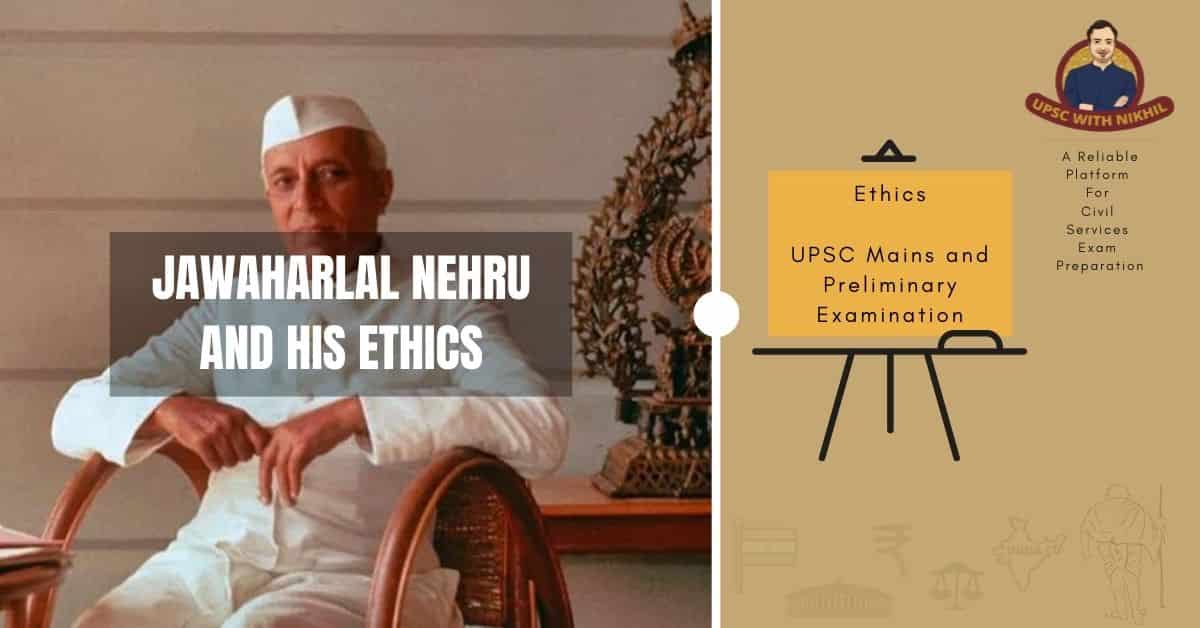
If Gandhi ji is known as the father of the country, Nehru is known as the architect of contemporary India. Jawaharlal Nehru (14 November 1889 – 27 May 1964), the son of Motilal Nehru, was a key factor in bringing India's independence war to a successful conclusion. Jawaharlal Nehru is one of Gandhi's most illustrious lieutenants in the war for independence.
• Although the matter of leadership had been settled as far back as 1941, when Gandhi recognised Nehru as his political heir and successor, Nehru was elected by the Congress to become independent India's first Prime Minister. Nehru set out to actualize his vision of India as Prime Minister. He started on an ambitious programme of economic, social, and political changes after the Indian Constitution was formed in 1950.

• As the architect of India's modern state, Nehru oversaw the country's transition from monarchy to republic while cultivating a plural, multi-party democracy. Nehru led the Non-Alignment movement in foreign policy, presenting India as a regional hegemony in South Asia.
• For nearly two decades, he was an uncontested leader who had great power over India's politics.
Complete independence
• In the pre-independence era, Nehru's primary contribution was that he campaigned for the objective of complete freedom for India. Nehru was one of the first leaders to demand that the Congress Party commit to cut all links with the British Empire completely and explicitly.
• In 1927, he proposed a resolution calling for "Complete National Independence," which was rejected due to Gandhi's opposition. On the midnight of December 31, 1929, he was the president of the INC's Lahore session, which passed a momentous independence resolution.
• Gandhi returned to a more spiritual role after the Congress session in Lahore in 1929, and Nehru eventually emerged as the foremost leader of the Indian independence movement. In the 1942 movement, he was imprisoned for nearly three years.
Ideal of Democracy

• Many countries that gained independence at the same time as India fell into dictatorships in their early years, but Nehru never allowed this to happen in India. Nehru was always a democratic leader, influenced by Gandhi's moral approach to politics of nonviolence and peace.
• Nehru could have shaped India's polity in any way he wanted with his power, but he stayed true to the democratic principle.
• Nehru was a fervent believer in parliamentary democracy, both in principle and in practise. He desired for India to catch up to the western sophisticated industrial nations, but not at the expense of democracy.
• He was never a fan of the authoritarian mechanised violence associated with Nazism and totalitarian regimes. His affection and deep dedication to civil liberty sprang out of the long and hard years of freedom struggle against British Empire.
Democratic institutions
• Nehru was instrumental in the formation of numerous institutions that are now regarded as cornerstones of democracy. Though several constitutional authorities, such as the Supreme Court and the Chief Election Commission, receive their authority from the constitution, they are held in high regard by the public due to the precedent set by Jawaharlal Nehru.
• Nehru always paid proper respect to the government's judicial branch, which aided in the maintenance of friendly relations. We often learn only how much respect and significance should be paid to a certain person or event from our elders.
• It was highly likely that the judiciary and parliament would have lost their worth if Nehru had not given them the respect and importance they deserved. Thus, even when the majority was with him and he might have led to the construction of a more strong executive, it was Nehru who always strove to maintain balance between different organs of the government.
Consensus building
• Even when it was not necessary for him, Nehru believed in consensus building and deliberation.
• Nehru was acutely aware of the delicate relationship between the centre and state governments, particularly in the setting of a skewed power balance in the centre’s favour. Only by making judgments based on conversations and reaching a consensus could the Centre win credibility and trust from states.
• He began writing to individuals in charge of administering state governments every two weeks shortly after independence. From 1947 to December 1963, this practise was continued.
• He justified the 1951 first amendment to the constitution as a result of "situational exigencies." A fundamental flaw in the democratic structure was the lack of a viable opposition capable of creating an alternative administration. Nehru was well aware of this discrepancy in the assessment of Indian democracy.
• As a result, he constantly placed a premium on disclosures and beginning debate, despite the fact that there was no significant resistance in the legislature to do so. The respect Nehru exhibited for the opposition, state governments, the press, and individuals with whom he differed reflected his dedication to democracy.
Institution building
• Nehru was not only a shaper of democratic institutions, but also a builder of institutions. As he launched reforms to enhance science and technology, planning and management, the industrial sector, and higher education in India, Nehru demonstrated his tenacity and willingness to take risks.
• The establishment of
a. IIMs
b. IITs
c. All India Institute of Medical Sciences (AIIMSs)
d. Atomic Energy Commission of India
e. Planning Commission
f. University Grants Commission
g. Atomic Energy Commission
h. The Defence Science Organisation
i. Basic and strategic industries
• Demonstrated his dedication to establishing new institutions in order to fulfil the demanding demands of rapid development. Nehru's leadership was energetic and inventive in this area. Despite a lack of enough resources and trained employees, the majority of the institutions he founded took root.
• In 1948, Nehru formed the Atomic Energy Commission of India (AEC) with the goal of creating nuclear weapons. Dr. Homi J. Bhabha, a nuclear physicist, was also invited by Nehru and given complete responsibility over all nuclear-related matters and programmes, reporting solely to Nehru. The unwritten personal understanding between Nehru and Bhabha established the tone for Indian nuclear strategy. "Professor Bhabha, take care of Physics, leave international relations to me," Nehru famously stated to Bhabha.
• Nehru had high ambitions to develop this programme to stand against the industrialised states from the beginning in 1948, and the foundation of this programme was to establish an Indian nuclear weapons capability as part of India's regional superiority over other South Asian states, most notably Pakistan.
• The main idea behind this goal was not to amass nuclear weapons in order to dominate other countries, but to gain equality so that he could negotiate on equal footing with others.
• Heavy industry development and speeding up the pace of development on the farm and in the factory were given top attention. "Countries are industrialised and advanced on the basis of steel and power," he believed.
• Simultaneously, he worked for 'trained employees' to carry out the policy effectively. Though the acceptance of a mixed economy highlighted the importance of the private sector, the rise of the public sector was critical.
Socialism
• At the Avadi session in January 1955, the INC adopted the vision of a socialist society under his leadership. The socialistic pattern implied social ownership or control of the primary means of production, increased national production, and a more fair distribution of national wealth.
• In a speech to the Lok Sabha, he stated that a socialist society is defined by equality, the elimination of inequities, and the opportunity for everyone to have a happy life.
Secularism
• Nehru created India's secular structure at a time when the country was vulnerable and communal tensions were high. Because he was not emotionally interested in religious debates, Nehru was an agnostic, rationalist, and realist. As a result, he was even acceptable to Mohammad Ali, and he had a close friendship with Abdul KalamAzaad.
• Culture, according to Nehru, instils genuine compassion, altruism, humanism, and loyalty to values such as liberty, equality, fraternity, human rights, rationalistic orientation, and modesty, but cultural loyalty and fidelity to justice can only come if one is free of fundamentalism and religious parochialism.
• The religious grounds for Hindu-Muslim conflicts did not persuade Nehru. He provided an economic analysis that stated that Hindus had better economic conditions than Muslims since English was a passport to government jobs and professions.
• The landlord, also known as the village baniya, was often a Hindu who was also the money lender and proprietor of the village store, putting Hindus in a position to oppress and exploit the tenants and small landowners, who were mostly Muslims.
• The minority communities in India were relieved by Nehru's commitment to secularism. His commitment to scientific technique resulted in the establishment of a secularist democracy.
Self determination
• Nehru was a strong supporter of national self-determination. Jawaharlal Nehru was largely important for popularising the concept of the constituent assembly as a soul valid organ for forming an Indian constitution.
• Nehru's belief in national self-determination was built on three pillars:
1. The British rulers' racial arrogance; racial chauvinism. Because they were better, Britishers believed they had the right to decide what was best for India.
2. Under British administration, the country was ravaged by poverty and exploitation.
3. The British had complete control over decision-making. They have always ignored Indian aspiration and public opinion. There was no Indian input into the decision-making process.
Internationalism
Nehru was a strong supporter of international cooperation. He had a strong dislike for limited, egoistic, and expansionist nationalism. The globe has become internationalised, according to Nehru (The Discovery of India), with international manufacturing, markets, and transportation. No country is truly self-sufficient; instead, they are all reliant.
As a result, some type of fusion between nationalism and internationalism is required. In 1954, he employed the Buddhist concept of panchasila in a secular context to describe the ideals of coexistence in a divided world, demonstrating his Buddhist influence. The Panchsheel (five qualities) Treaty, also known as the Five Principles of Peaceful Coexistence, is a collection of principles that governs interactions between states in India.
Nehru policy of non-alignment was based on three considerations:

1. India is a freshly independent country. She needs to focus on economic and social redevelopment. As a result, non-alignment is a logical policy for a newly formed nation state.
2. Historical reasons: India has always pursued a policy of peace throughout its history. Expansionist power politics have never been sanctioned by her.
3. The imperatives of international power politics encourage non-alignment. It was a good approach to strengthen the peace area in a hostile globe divided into armed sections. This can be accomplished if a number of countries refuse to join the opposing camps and instead act as mediators in reducing international tensions.
• As a result, he argued for a dynamic approach to non-alignment, in which states participate actively in the peace process rather than remaining neutral to the opposing camps.
• Many have criticised Nehru for pursuing a moralistic approach to foreign relations, but it was the existence of principles that gave India a unique voice in the world.
• No leader can deny the importance of national interests, but Nehru always articulated them in terms of universal principles such as peace, disarmament, equality, and fraternity. He advocated for a peaceful approach and accepted negotiation and mutual understanding tactics.
• To sum up, Nehru strove to promote India's democracy through his scientific approach and concern for human values. Threats to national solidarity and togetherness were mentioned in two of his addresses delivered in the latter months of his life. He emphasised that diversity should not detract from national unity, nor should religion, caste, or language.
• From Buddha to Gandhi, he remarked, India's tradition taught the world how to live in peace with one another. Democracy necessitated a spirit of tolerance and cooperation, and he was confident in India's ability to maintain that spirit. Nehru's trust in the Indian spirit remained unwavering throughout.
• We are not only industrialising the country through democratic methods, but also attempting to preserve the country's unique traits in Indian philosophy and way of life, as well as its individuality, he stated.