

Bhopal Gas Tragedy 1984
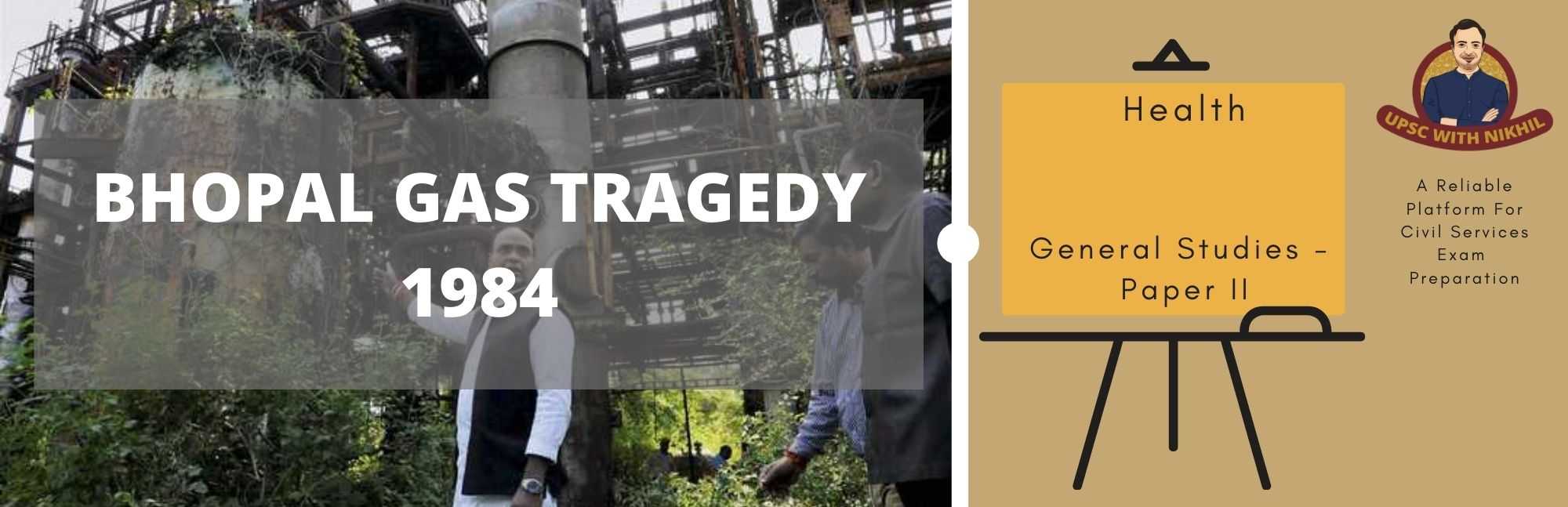
A gas leak at the Union Carbide India Limited (UCIL) pesticide plant in Bhopal on the night of 2 December 1984 resulted in the deaths of approximately 4000 people and adversely affected the health of lakh's of people. The after-effects of the tragedy continue to this day. More information about the Bhopal Gas Tragedy is discussed in this article.

HISTORY BEHIND THE GAS LEAK:
- UCIL was a pesticide plant, which under the brand name Sevin, developed the pesticide carbaryl (chemical name: 1-naphthyl methylcarbamate).
- An American company, Union Carbide Corporation (UCC), which was the parent company of UCIL and owned a majority stake, discovered Carbaryl.
- UCIL has developed carbaryl using methyl isocyanate (MIC). Although there are other strategies for manufacturing the end-product, they cost more.
- MIC is a compound that is highly poisonous and particularly harmful to human health.
- Bhopal residents surrounding the pesticide plant began to feel the irritating effects of MIC at around midnight on 2 December 1984 and began fleeing from the area. By morning, however, thousands were dead.
REASONS FOR BHOPAL GAS LEAK IN 1984:
- India's government and activists accuse UCIL of breaching safety regulations and neglecting proper protocols for maintenance and safety. The plant's protection devices for the highly poisonous MIC were not working during the build-up to the spill.
- There were many valves and lines in disrepair, and many vent gas scrubbers were out of operation, as well as the steam boiler intended for cleaning the pipes was also out of operation.

- The MIC was contained in three tanks and the leak occurred in tank E610. This tank held 42 tonnes of MIC but according to safety regulations, it should have held just 30 tonnes.
- Water is thought to have penetrated a side pipe and into the tank while employees were attempting to unclog it during the late hours of that fateful night. This triggered an exothermic reaction in the tank and slowly raised the pressure of the tank, resulting in the gas being vented atmospherically.
- The workers inside the plant start to experience the effects of the toxin by 11:30 PM.
- In the factory, three safety devices could have avoided the tragedy if they had been operating properly: a cooling system, a flare tower, and a vent gas scrubber. The cooling device was intended to cool the MIC tank, the flare tower was intended to burn the escaping MIC, and the gas scrubber, which was turned off at that time, was too weak to handle this scale's calamity. Within 2 hours, approximately 40 metric tonnes of MIC escaped into the atmosphere.

WHAT WERE THE EFFECTS OF BHOPAL GAS TRAGEDY?
- Thousands of people had died due to choking, pulmonary edema, and reflexogenic circulatory collapse by the morning of December 3rd. Autopsies found that not only the lungs but nerves, kidneys, and liver of individuals were also affected.
- The rate of stillbirth increased by 300 percent and the rate of neonatal mortality increased by 200 percent.
- In Bhopal, there were mass burials and cremations.
- A large number of animal carcasses being seen in the vicinity which shows impact on flora and fauna. Within a few days, the trees were barren. Owing to the fear of contamination, food supplies have become limited. Fishing was also banned.
- In March 1985, the Indian government passed the Bhopal Gas Leak Disaster Act, which granted the government the right to represent all victims of the disaster legally, whether in India or elsewhere.
- At least 200,000 children were exposed to the gas, and because of their tiny heights, they were more vulnerable.
- Hospitals were overwhelmed with victims and there was no proper preparation for medical personnel to cope with MIC exposure.
- In the US Federal Court, cases have been brought against UCC. The court requested in one case that UCC provide between $5 million and $10 million to help the victims. UCC decided that $5 million would be paid. But this bid was rejected by the Indian government and $3.3 billion was claimed.
- In 1989, an out-of-court settlement was reached when UCC agreed to pay $470 million for damages incurred and paid the amount promptly.
- In 1991, Warren Anderson, the CEO and Chairman of UCC at the time of the disaster was charged with manslaughter by the Bhopal authorities. He failed to appear in court after being convicted and was ruled a fugitive by the Bhopal court in February 1992. Nothing came of it, even though the central government forced the US to extradite Anderson, he never faced a trial and died in 2014.
EVENTS AFTER THE BHOPAL GAS TRAGEDY:
- In 2010, 7 former UCIL workers were sentenced to 2 years in jail and fined Rs 1 lakh for negligence causing death. They were all in their seventies and were freed on bail.
- The gas leak has serious long-term health consequences on the people. Issues include chronic eye problems, respiratory tract problems, trauma-based neurological and psychological problems. There are issues with children that have been exposed, such as stunted development and intellectual impairments.
- In a 2014 survey, survivors are still suffering from extreme medical problems, including birth defects for subsequent generations and elevated cancer and tuberculosis rates.
- There is also an issue with the handling of radioactive waste lying inside and near the plant. The groundwater and the soil were also seriously contaminated.
- The battle for justice is still underway for the victims of this man-made tragedy.
- It was announced in June 2020 that survivors of the Bhopal Gas Tragedy and their children accounted for 80 percent of the Covid-19 deaths in the city of Bhopal in the wake of the Wuhan Coronavirus pandemic. In the coming days, deaths will rise as the virus targets those with compromised immune systems.

WHAT SORT OF PREPAREDNESS IS NOW REQUIRED?
- The first and most far-reaching measure to be taken is to provide an on-site and off-site plan: the on-site plan is capacity building for individuals inside the industry. Basic information should be given to staff, understanding of dangerous gases or chemicals being used in the industry, ongoing input to staff, do's and don'ts when incidents occur and mock drills should be performed regularly.
- The offsite strategy: Consciousness should be granted to the public. To prevent panics and rumors, their involvement and cooperation are very important, these things are crucial, particularly for people living near the industries' vicinity.
- For eg, if people had been little aware of covering their faces, esp. eyes with a wet cloth during the Bhopal gas tragedy, much of the damage could have been minimized. This should be the industry's compulsory obligation.
- A Disaster Management Institute was opened after the Bhopal gas tragedy. Many more institutions should also be opened near the industrial belts to train the man power.
- In 2005, Parliament adopted an act and NATIONAL DISASTER MANAGEMENT AUTHORITY was established. It also authorizes each state to release funds to prepare a state plan and a district plan. At the state level, this is being followed, but not so consistently at the level of the district.
- In India, there are close to 300 districts with a big accidental risk unit. With the local government, police, media, fire stations, there must be a strong link and cooperation.
- These organizations should have training and expertise imparted. Local authorities that review licenses and check the safety standards of these industries are crucial. The police and the fire brigade should be well equipped to take immediate action when accidents occur.
- Through research, vulnerable areas, vulnerable sites, and hot spots can be identified and the database should be maintained by district authorities.
- There are over 20 universities that offer disaster management degrees. Concerning chemical disasters, it should be made mandatory for IITs and all engineering institutions to impart some knowledge in the field of industrial management.
- To prevent rumors, misconceptions, and miscommunication, a national public awareness campaign is needed.